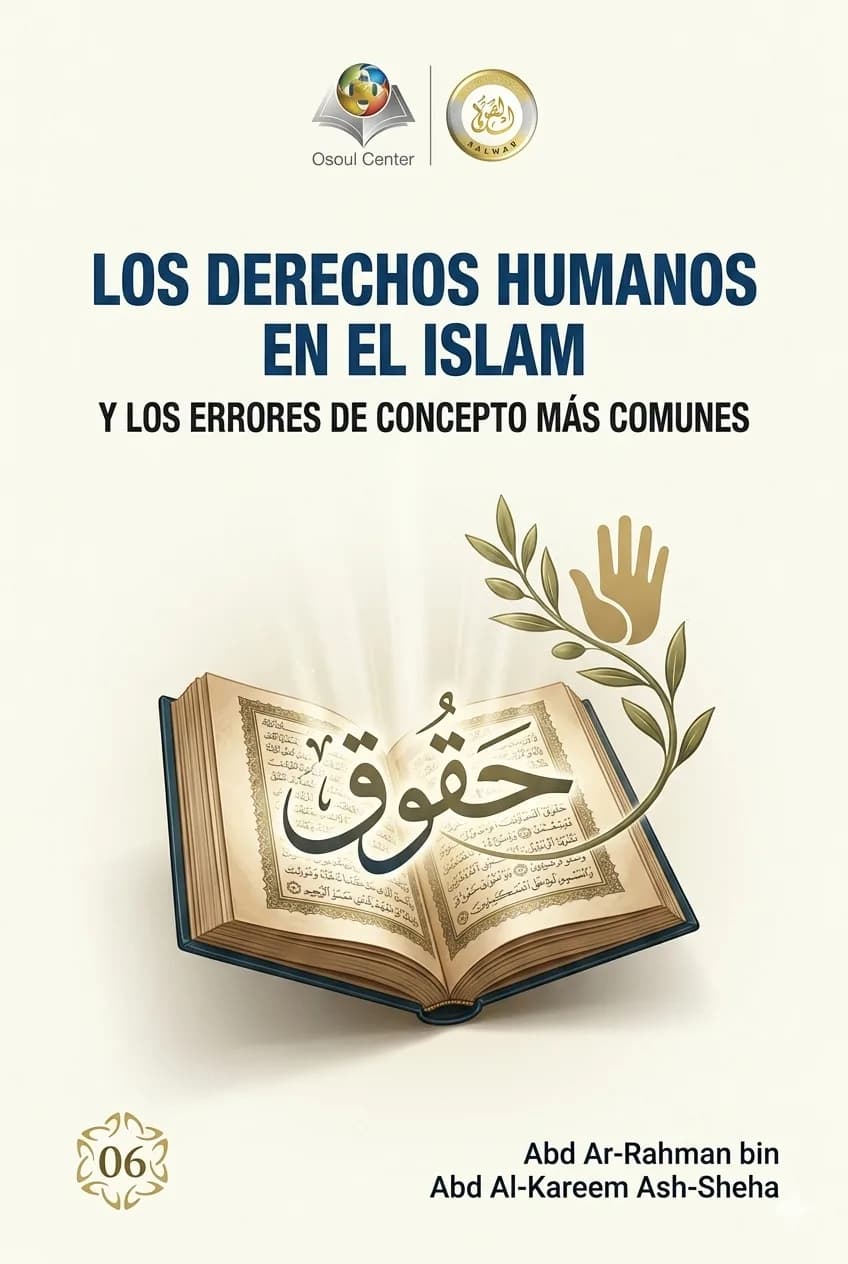
"Human Rights in Islam and the Most Common Misconceptions"
 EN
EN ES
ESHuman Rights in Islam and the Most Common Misconceptions
"This book serves as a comprehensive conceptual guide that sheds light on the authentic Islamic perspective on human rights, demonstrating how Islamic law preceded international conventions in safeguarding human dignity. The book discusses the five essential necessities for preserving life, as well as fundamental human needs, while highlighting the justice of the Islamic judicial system in comparison to global human rights declarations, alongside refuting the most common misconceptions and errors in understanding this issue."
This book presents a foundational and comparative study on the concept of human rights in Islam, primarily aiming to highlight Islamic precedence in this field and to correct the stereotypes and common misconceptions raised about it. The content of the book, based on its main themes, is divided into several essential pillars, beginning with an exploration of the Islamic vision for protecting the five core necessities without which human life cannot be upright: the preservation of religion, life, intellect, lineage and property, and how Sharia formulated its rulings to protect them. The work also discusses Islam’s guarantee of living requirements and basic human needs that ensure a decent life and social justice. Furthermore, the book dedicates significant space to examining the judicial system in Islam, clarifying the mechanisms for achieving justice and equality before the law without discrimination, and how an independent judiciary stands as a fortress protecting individuals. It also analyzes and compares the Islamic Declaration of Human Rights, highlighting the characteristics of these rights as stemming from a constant divine honoring rather than mere temporary grants or alterable man-made laws. The book focuses particularly on addressing and refuting common intellectual and conceptual errors regarding the application of human rights in the Islamic system, employing a scientific and dialogical approach to clarify facts and respond to misconceptions. The book concludes with a summary proving that human dignity and rights are an integral part of Islamic creed and law, rather than just temporary slogans.
Osoul Global Center
Publisher
Osoul Global Center y organization dedicated to the preparation, development, and enhancement of Islamic dawah content in many world languages. It operates with a clear vision and a commitment to high academic and scholarly standards, aiming to make authentic Islamic knowledge accessible to a global audience.
website:
https://osoulstore.com/
books (free):
https://osoulstore.com/
Donate:
https://donate.osoulcontent.org.sa/
Muhammad Isa García
Translator
Muhammad Isa García is one of the most prominent contemporary Spanish-speaking translators, preachers and academics in the Islamic world. Born in Argentina, he embraced Islam at an early age and later moved to Saudi Arabia, where he studied Islamic sciences and graduated from the Islamic University of Madinah.
García has dedicated his career to translating Islamic literature into Spanish, aiming to fill a significant gap in the Spanish speaking Islamic library. Among his most notable achievements is the translation of the meanings of the Holy Quran into contemporary Spanish with a precise and smooth style, in addition to translating hundreds of Islamic books and research papers (including "Is the Quran the Word of God?"). He is highly respected among Muslim communities in Latin America and Spain for his continuous educational and Dawah efforts.
Human Rights in Islam and the Most Common Misconceptions_EN
ENHuman Rights in Islam and the Most Common Misconceptions_EN
PDFENHuman Rights in Islam and the Most Common Misconceptions_ES
ESHuman Rights in Islam and the Most Common Misconceptions_ES
PDFESHuman Rights in Islam and the Most Common Misconceptions_EN
ENHuman Rights in Islam and the Most Common Misconceptions_EN
pdfEN