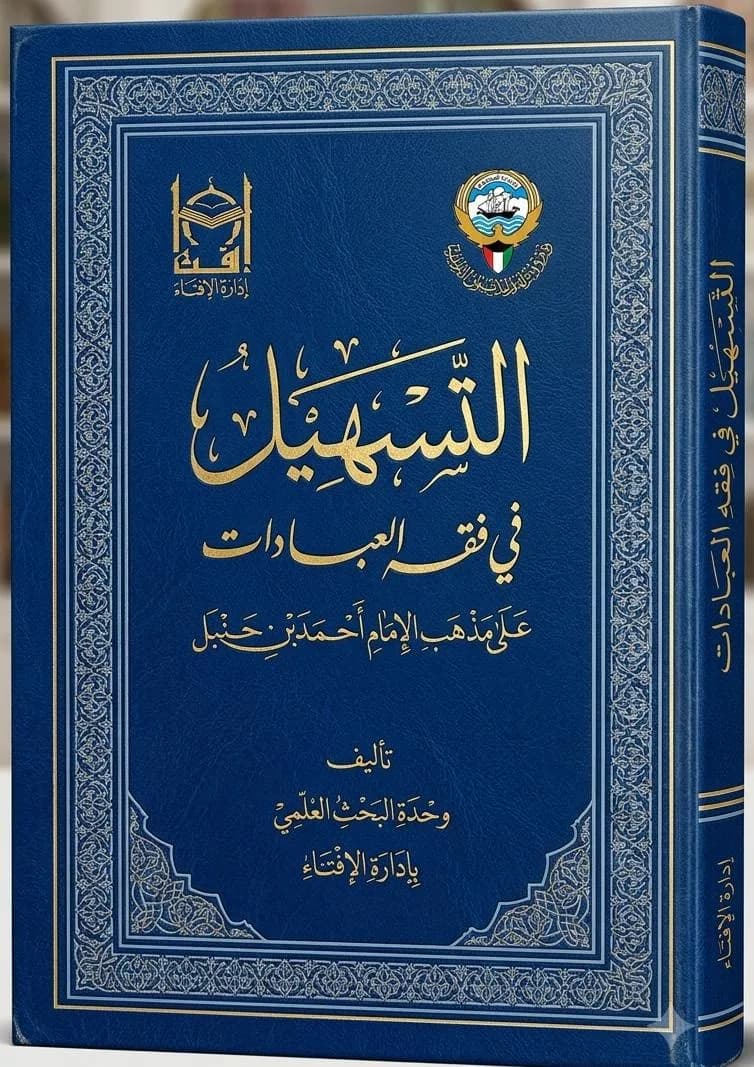
"The Facilitation in the Jurisprudence of Acts of Worship"
 AR
ARThe Facilitation in the Jurisprudence of Acts of Worship
"The book "The Facilitation in the Jurisprudence of Acts of Worship according to the School of Imam Ahmad bin Hanbal" is a simplified and authenticated jurisprudential guide issued by the Ministry of Awqaf and Islamic Affairs in the State of Kuwait (prepared by the Scientific Research Unit of the Fatwa Administration). The book aims to facilitate the jurisprudence of acts of worship and bring its rulings closer to the general public and students of Islamic knowledge, in accordance with the weighted and approved views within the Hanbali school. It seeks to achieve the ultimate purpose of creation, which is the proper worship of Allah based on insight and knowledge, using a contemporary approach free of complexity."
The book "The Facilitation in the Jurisprudence of Acts of Worship according to the School of Imam Ahmad bin Hanbal" comes as a reflection of the great care that the State of Kuwait dedicates to the four schools of jurisprudence in general and the Hanbali school in particular. This dedication extends historically through hosting prominent scholars of the school, organizing educational courses, and printing jurisprudential works, continuing a deeply rooted Kuwaiti scholarly heritage represented by prominent Hanbali figures in the state's history, such as Sheikh Muhammad bin Abdullah Al-Faris, Sheikh Abdullah bin Khalaf Al-Dahyan and Sheikh Muhammad bin Sulaiman Al-Jarrah, among others who carried the banner of this knowledge within Kuwaiti society.
The mission of this book stems from a Sharia-based vision asserting that gaining a deep understanding of religion is among the most honorable sciences in status and the greatest in reward and that a servant’s salvation and happiness in both worlds are tied to the proper worship of Allah Almighty. This objective can only be achieved through learning and seeking knowledge, understanding what is permissible and what is forbidden and distinguishing between the allowed and the prohibited, so that human actions are built on insight and knowledge of the correct Sharia path.
The book is distinguished by rigorous institutional teamwork, as it was prepared and drafted by a specialized research team from the Scientific Research Unit of the Kuwaiti Fatwa Administration, headed by Sheikh Turki Isa Al-Mutairi and co-authored by Dr. Ayman Muhammad Al-Omar, Sheikh Nour El-Din Abd El-Salam Masai and Sheikh Ahmad Abdel Wahab Salem. The team focused on drafting the issues of worship in a contemporary style characterized by facilitation and accessibility to suit various knowledge levels, while precisely structuring and grounding them in accordance with the approved and established doctrines of the Hanbali school.
Fatwa Administration of the Ministry of Awqaf and Islamic Affairs in the State of Kuwait
Publisher
The Fatwa Administration of the Ministry of Awqaf and Islamic Affairs in the State of Kuwait is one of the leading official jurisprudential institutions in the Islamic world, serving as the primary Sharia authority in the country for issuing fatwas and guiding society in accordance with the tolerant principles of Islamic law. Official fatwa work in Kuwait has undergone several organizational stages, beginning with the establishment of the first official fatwa committee in 1952 by a decision of the Kuwait Knowledge Council. This was followed by a ministerial decision in 1966 that officially integrated it into the Ministry of Awqaf, culminating in the issuance of an Amiri Decree in 1977 to establish the "Fatwa Board". This board became the supreme and central body tasked with issuing general fatwas on major issues and contemporary developments through rigorous, specialized sub-committees. The administration's mission centers on providing Sharia rulings based on a methodology of moderation and balance, relying on collective ijtihad (reasoning) to address economic, medical, and social developments. It also aims to promote cultural and religious awareness, simplify jurisprudential knowledge for the public, and fulfill a humanitarian and dawah role in caring for new converts by documenting their conversion to Islam and providing cultural support in their respective languages. Through decades of massive scientific and documentary efforts, the administration has enriched the Islamic library. Notable among its contributions is the encyclopedia "Al-Durar Al-Bahiyyah min Al-Fatawa Al-Kuwaitiyyah", which documents the official fatwas issued by the board and serves as a global jurisprudential reference, in addition to a series of in-depth research papers on contemporary issues such as modern financial transactions, and the publication of the "Fatwa Journal", a peer-reviewed scientific periodical dedicated to publishing Sharia research and the academic grounding of contemporary ijtihad.
Translator Not Available
Translator information will be added soon