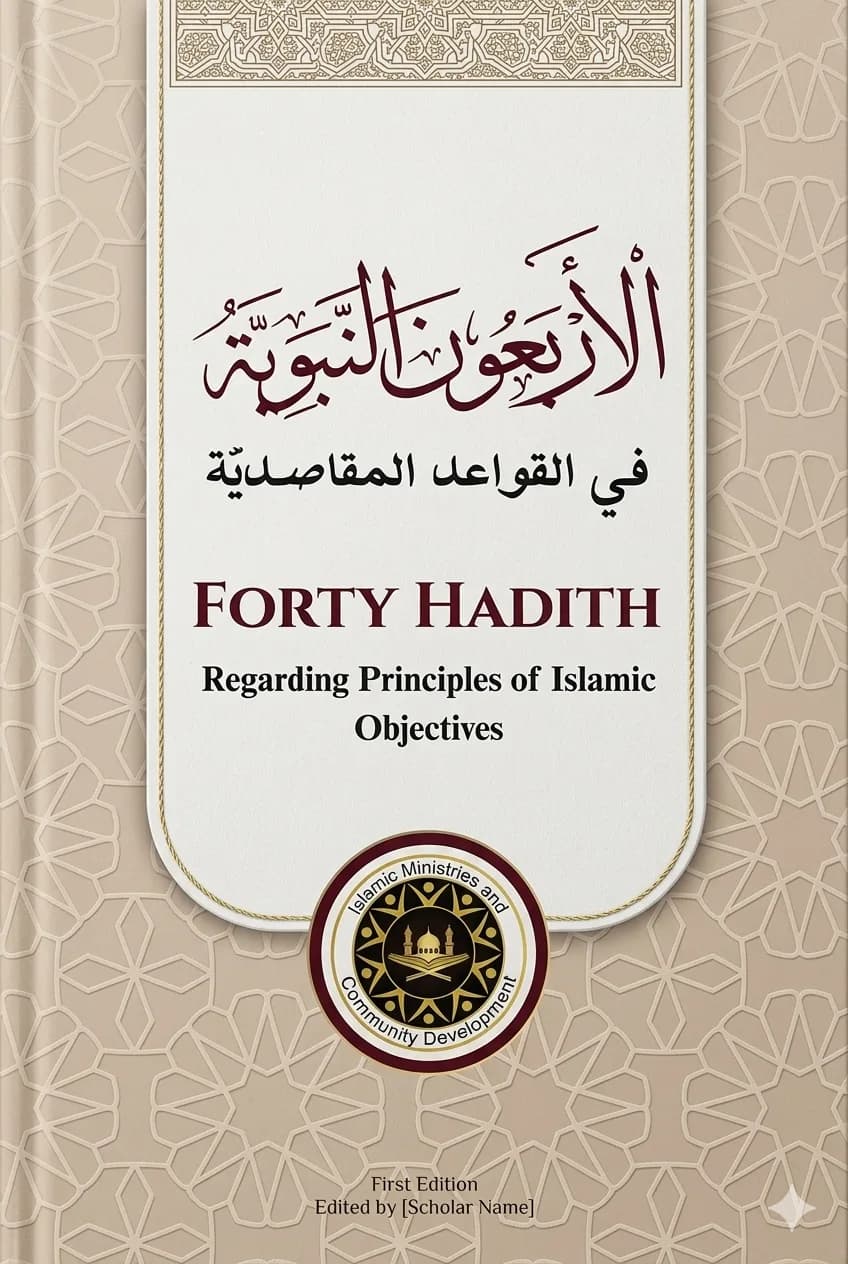
"Forty Hadith Regarding Principles of Islamic Objectives"
 EN
ENForty Hadith Regarding Principles of Islamic Objectives
""Forty Hadith Regarding Principles of Islamic Objectives" is a valuable work that bridges the Prophetic Sunnah with the science of Maqasid al-Shari'ah (Higher Objectives of Islamic Law). The book revolves around 42 core thematic and objective-based principles derived from the honorable Prophetic Hadiths. It aims to demonstrate that Islamic legislation is fundamentally built upon maximizing benefits (Masalih) and minimizing harms (Mafasid), as well as preserving the Five Necessities (Religion, Life, Intellect, Honor and Wealth) Furthermore, it emphasizes the flexibility, ease and timeless relevance of Shari'ah through precise jurisprudential and legal maxims."
This book serves as a foundational guide that connects Hadith literature with the objectives and philosophy of Islamic legislation. Rather than merely listing Hadiths, it utilizes them as textual evidence to formulate forty-two overarching maxims upon which legal rulings are built and through which the process of Ijtihad (independent juristic reasoning) is guided.
The book initiates its themes by outlining the universal principles of Shari'ah and the preservation of human welfare, establishing that Islam is entirely based on absolute benefit, maximizing public good and minimizing harm, while detailing the rules of prioritization when benefits conflict such as prioritizing public interest over private interest, greater benefits over lesser ones and the everlasting rewards of the Hereafter over transient worldly gains.
Additionally, the book devotes significant space to anchoring the "Five Necessities" universally protected by all divine laws: Religion, Life, Intellect, Honor and Wealth, alongside establishing social justice as a grand principle and safeguarding human dignity as an inherent right for all mankind.
The author also highlights the inherent ease, flexibility, and removal of hardship in Islamic law by explaining the jurisprudence of necessity and its famous maxims, such as "Necessity renders the forbidden permissible" and "Necessities are estimated proportionally" It illustrates how a general public need can be treated with the same leniency as a necessity, while clarifying that hardship in worship is never intended for its own sake, but rather spiritual reward is proportional to inherent, unavoidable hardship.
In a related context, the book addresses the jurisprudence of outcomes and means it emphasizes evaluating the consequences of actions, establishing that "means share the same rulings as their objectives" while prioritizing objectives over means and blocking the ways to corruption (Sadd al-Dhara'i'). It reviews the objective-based criteria that distinguish acts of devotion (which are based on pure submission) from worldly transactions (which are based on rational underlying causes and human welfare), while strictly forbidding legal stratagems (Hiyal) that contradict divine objectives. It also cements rules of personal responsibility, such as the non-obligation of the unbearable and the principle that no individual shall be held accountable for another's crime.
Ultimately, the book concludes by linking Shari'ah to sound human nature (Fitrah) and intellect, affirming that Islamic law never contradicts reason or logic but rather reinforces them. It stresses that freedom of choice is the baseline for human actions, and that understanding the Higher Objectives of Shari'ah is the fundamental pillar for contemporary Ijtihad, without which correct rulings for modern legal dilemmas cannot be derived. Consequently, this book serves as an indispensable intellectual toolkit that shapes a balanced Islamic mindset, successfully marrying textual authenticity with objective contemporary relevance.
Islamic Ministries and Community Development (IMACD)
Publisher
Islamic Ministries and Community Development (IMACD) is a non-profit Islamic organization based in Hagerstown, Maryland. Driven by a deep commitment to humanitarian and educational work, the organization focuses its efforts on two parallel paths: first, promoting the true values and principles of Islam to English-speaking communities through well-crafted educational booklets and awareness materials; and second, fostering community development through relief services, such as food drives and clothing distribution for those in need. In achieving its mission, IMACD relies heavily on cultivating a culture of solidarity and volunteerism to serve the wider community. For more information, please visit
the official website:
https://imacd.org/
Translator Not Available
Translator information will be added soon
FORTY HADITH Regarding Principles of Islamic Objectives_EN
ENFORTY HADITH Regarding Principles of Islamic Objectives_EN
PDFEN