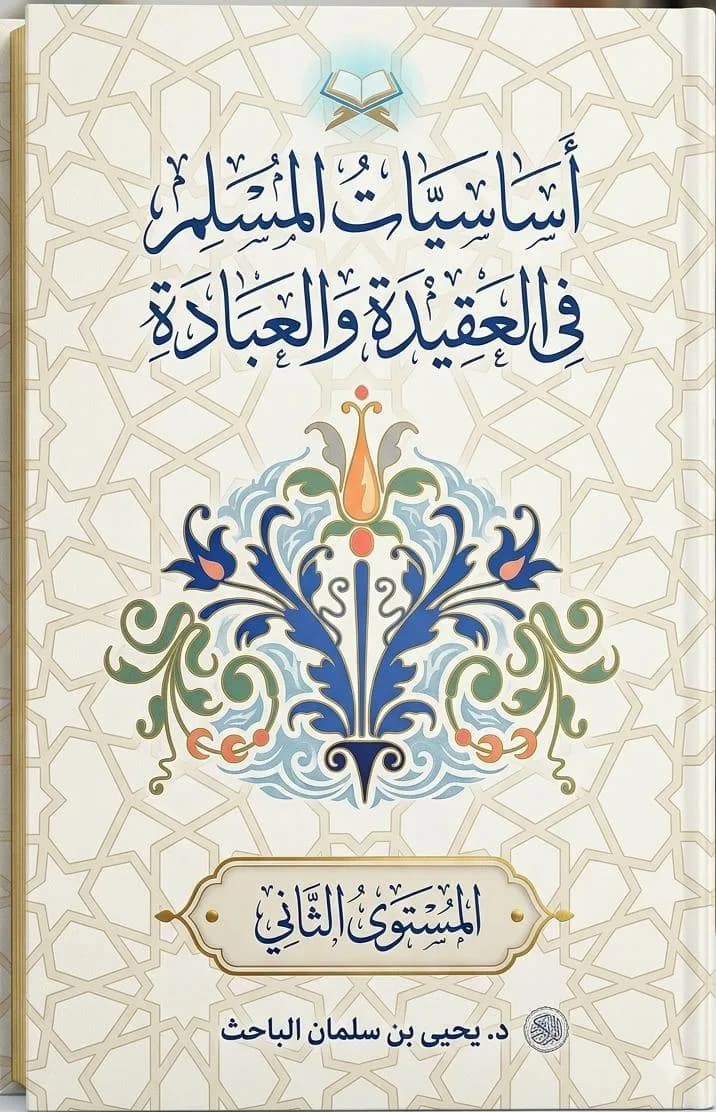
"The Muslim's Essentials in Creed and Worship (Second Level)"
 AR
AR EN
ENThe Muslim's Essentials in Creed and Worship (Second Level)
""The Muslim's Essentials in Creed and Worship (Level Two)" by Dr. Yahya bin Salman Al-Bahith is a comprehensive educational and nurturing guide, designed to be an advanced step in building correct religious awareness for Muslims. The book blends the core foundations of Islamic Creed (Aqeedah) covering the pillars of faith and warning against polytheism (Shirk) with detailed rulings on daily and seasonal acts of worship (Ibadah), such as purification, prayer, zakat, fasting and Hajj and Umrah, along with insightful guidance on a Muslim's daily conduct and lifestyle. It is distinguished by its clear approach, reliance on Sharia evidence and inclusion of practical and written exercises to solidify knowledge and transform it into lived practice."
"The Muslim's Essentials in Creed and Worship (Level Two)" by Dr. Yahya bin Salman Al-Bahith represents a foundational cornerstone in a progressive educational and nurturing curriculum aimed at enabling Muslims to understand the core tenets of their religion and apply its jurisprudential rulings with conscious insight. The book bridges the academic grounding of Islamic rulings with the contemporary reality of Muslims through a smooth, accessible style that relies directly on Sharia evidence from the Quran and Sunnah. It begins its educational journey with the Creed (Aqeedah) unit, which details the six pillars of faith while highlighting the fragrant prophetic biography, the life of Prophet Muhammad (peace be upon him) and his unique characteristics. This is followed by a clear study of the meaning, types and forms of polytheism (Shirk) to safeguard correct belief.
The book then transitions into the practical, jurisprudential side through several units, starting with the rulings of purification (Taharah), such as practical purification, wiping over leather socks (Khuffayn), dry ablution (Tayammum) and ritual bathing (Ghusl), with dedicated sections for the purification of Muslim women. It then covers the rulings of prayer (Salah), detailing congregational prayer, the call to prayer (Adhan), its etiquettes and the rulings for prostrations of forgetfulness (Sahw) and recitation (Tilawah), moving towards prayers for special occasions such as Friday prayer, Eid prayers, funeral prayers, and the prayer of travelers and the sick all supported by a dedicated unit for the remembrances (Adhkar) of prayer and the contemplation and virtues of short chapters (Surahs) like Al-Fatiha, Al-Ikhlas and the Mu'awwidhatayn.
Furthermore, the book does not overlook financial and seasonal acts of worship; it reviews the rulings of Zakat, the wealth subject to it, and its legitimate channels of distribution, alongside the jurisprudence, Sunnahs, and etiquettes of fasting and the rulings of making up missed days in Ramadan. It also provides a simplified, methodical guide to the rituals, pillars and expiations (Fidyah) of Hajj and Umrah, concluding its content with an integrated unit on the daily life of a Muslim that regulates general conduct, from the rulings of food, drink, clothing, to economic and financial life, alongside specific guidance for the life of Muslim women.
This work is distinguished by its unique practical methodology, as it includes intensive written and practical exercises after each lesson to reinforce concepts and transform jurisprudential knowledge into accurate daily practice, making it an ideal educational reference for Islamic schools, institutes and centers, and an indispensable guide for every Muslim seeking to correct their worship and strengthen their creed.
The King Fahd National Library
Publisher
The King Fahd National Library is the most prominent cultural center dedicated to preserving the intellectual heritage, Arabic studies and Islamic research in the Kingdom of Saudi Arabia. The library was established as a tribute and expression of loyalty from the residents of Riyadh to King Fahd bin Abdulaziz may he rest in peace on the occasion of his accession to the throne in 1982, with the project officially announced in 1983. It was later designated as the official national library under its own regulatory decree, offering comprehensive services to researchers and publishers.
The library plays a pivotal role in organizing the documentation and publishing movement within the Kingdom. It is the official authority responsible for implementing the Legal Deposit System, issuing International Standard Book Numbers (ISBN) for publications and compiling the National Bibliography to catalog Saudi intellectual output. Furthermore, the library houses vast collections of rare manuscripts, historical documents, coins and microfilms, serving as the Kingdom's national repository of knowledge and the primary reference for authors and researchers.
Translator Not Available
Translator information will be added soon
The Muslim's Essentials in Creed and Worship (Second Level)_AR
ARThe Muslim's Essentials in Creed and Worship (Second Level)_AR
PDFARThe Muslim's Essentials in Creed and Worship (Second Level)_EN
ENThe Muslim's Essentials in Creed and Worship (Second Level)_EN
PDFENThe Muslim's Essentials in Creed and Worship (Second Level)_AR
ARThe Muslim's Essentials in Creed and Worship (Second Level)_AR
pdfAR